
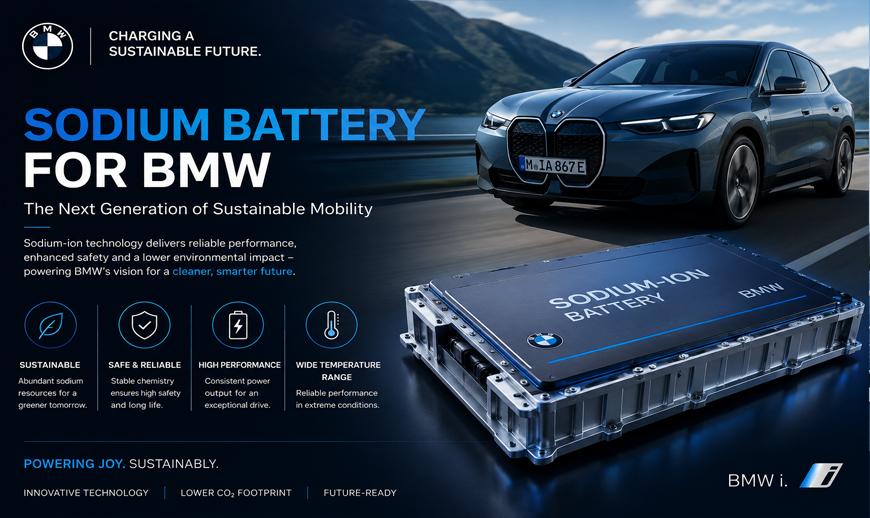
Next-Generation Sodium Battery Solutions for BMW Vehicles
Discover the future of automotive energy storage with Sodium-Ion Battery technology for BMW. Designed to offer enhanced safety, sustainability, and long-term reliability, sodium-ion batteries are emerging as a promising alternative to conventional lithium-ion batteries for selected automotive applications.
With abundant raw materials, improved thermal stability, and a lower environmental footprint, sodium-ion technology is attracting attention as the next generation of battery innovation for electric mobility and energy storage.
What is a Sodium Battery?
A Sodium-Ion Battery (Na-Ion Battery) is a rechargeable battery that uses sodium ions (Na⁺) instead of lithium ions to store and release electrical energy. Because sodium is widely available and more abundant than lithium, sodium-ion batteries have the potential to provide a more sustainable and cost-effective energy storage solution.
Why Choose a Sodium Battery for BMW?
Enhanced Safety
Sodium-ion batteries offer excellent thermal stability, reducing the risk of overheating and improving overall battery safety.
Sustainable Battery Technology
Made from abundant sodium resources, these batteries help reduce dependence on critical raw materials and support environmentally responsible manufacturing.
Long Service Life
Engineered for thousands of charging and discharging cycles, providing reliable performance over time.
Reliable Performance
Delivers stable power output across a wide range of operating conditions, making it suitable for future mobility applications.
Lower Environmental Impact
Supports greener transportation through sustainable battery chemistry and recyclable materials.
Potential Applications
Sodium battery technology can be used in various automotive and energy storage applications, including:
- Passenger vehicles
- Electric vehicles (future platforms)
- Hybrid vehicle systems
- 12V auxiliary battery systems
- Fleet vehicles
- Automotive research and development
- Mobility innovation projects
- Energy storage for EV charging infrastructure
Important: Sodium-ion batteries are still an emerging technology for passenger vehicles. Most BMW electric vehicles currently use lithium-ion battery systems. Always verify compatibility with your specific BMW model and consult a qualified automotive battery specialist before considering any battery replacement.
Key Features
- Advanced sodium-ion chemistry
- High thermal stability
- Long cycle life
- Safe and reliable operation
- Fast charging potential
- Intelligent Battery Management System (BMS)
- Low maintenance requirements
- Stable voltage output
- Environmentally friendly materials
- Durable battery construction
Advantages of Sodium-Ion Technology
Improved Safety
Lower risk of thermal runaway compared to many conventional lithium-ion battery chemistries.
Abundant Raw Materials
Sodium is one of the most readily available elements, supporting more sustainable battery production.
Cost Potential
As manufacturing scales, sodium-ion batteries are expected to become more economical for many applications.
Renewable Energy Integration
Can also be used in stationary battery systems that support solar charging and EV infrastructure.
Sodium-Ion vs. Lithium-Ion Batteries
| Feature | Sodium-Ion Battery | Lithium-Ion Battery |
|---|---|---|
| Safety | Excellent thermal stability | Good with thermal management |
| Raw Material Availability | Very high | Limited |
| Sustainability | High | Moderate |
| Cost Potential | Lower at scale | Higher due to lithium demand |
| Energy Density | Improving | Generally higher today |
| Ideal Applications | Stationary storage, selected automotive applications | Most current EV traction batteries |
Industries That Benefit
Sodium-ion battery technology is suitable for:
- Automotive manufacturers
- EV research and development
- Fleet operators
- Battery system integrators
- Universities and research institutes
- Renewable energy projects
- Smart mobility initiatives
- Energy storage providers