
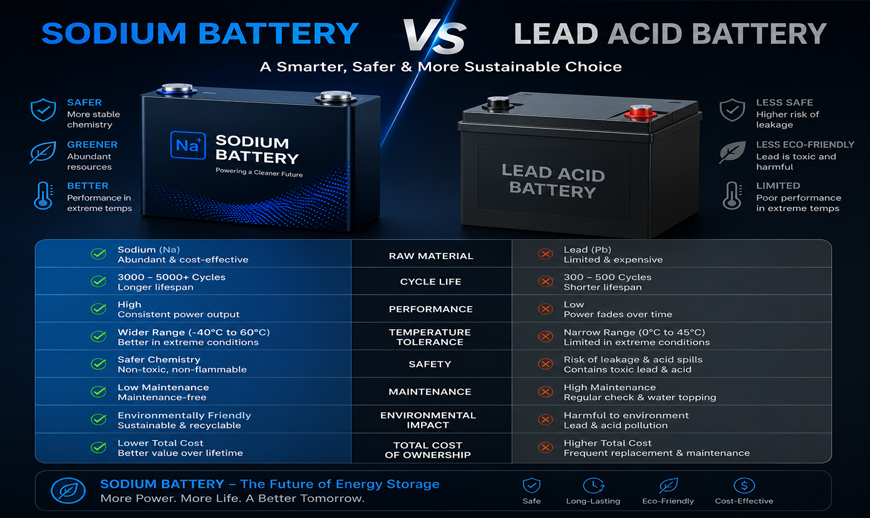
Sodium Battery vs Lead Acid Battery: Which Is the Better Choice?
When choosing an energy storage solution, understanding the differences between Sodium-Ion Batteries and Lead Acid Batteries is essential. While lead acid batteries have been widely used for decades, sodium-ion battery technology offers significant improvements in safety, lifespan, efficiency, and sustainability.
Whether you’re looking for a battery for solar energy storage, backup power, commercial applications, or industrial use, sodium-ion batteries provide a modern and future-ready alternative.
What is a Sodium Battery?
A Sodium-Ion Battery is a rechargeable battery that stores energy using sodium ions (Na⁺). It is designed to deliver high safety, long cycle life, fast charging, and environmentally friendly energy storage.
Common Applications
- Solar energy storage
- Residential backup power
- Commercial buildings
- Industrial facilities
- Battery Energy Storage Systems (BESS)
- Telecommunications
- Data centres
- Renewable energy projects
What is a Lead Acid Battery?
A Lead Acid Battery is a traditional rechargeable battery that uses lead plates and sulfuric acid to store electrical energy. It has been widely used in automotive, UPS, and backup power applications due to its low initial cost.
Common Applications
- Automotive starter batteries
- UPS systems
- Emergency lighting
- Backup power
- Golf carts
- Forklifts
- Marine applications
Sodium Battery vs Lead Acid Battery Comparison
| Feature | Sodium-Ion Battery | Lead Acid Battery |
|---|---|---|
| Technology | Sodium-ion chemistry | Lead-acid chemistry |
| Safety | Excellent thermal stability | Generally safe when properly maintained, but contains corrosive acid |
| Cycle Life | Typically several thousand charge/discharge cycles | Typically a few hundred to around 1,500 cycles, depending on battery type and depth of discharge |
| Charging Speed | Faster charging | Slower charging |
| Maintenance | Low maintenance | Some types require regular maintenance |
| Weight | Generally lighter | Heavier |
| Energy Efficiency | Higher | Lower |
| Operating Temperature | Good performance across a wide temperature range | Performance can decline in extreme temperatures |
| Environmental Impact | Uses abundant sodium and avoids lead | Contains lead and sulfuric acid, requiring careful recycling |
| Renewable Energy Integration | Excellent | Good |
Advantages of Sodium-Ion Batteries
Enhanced Safety
Sodium-ion batteries provide excellent thermal stability and are designed to reduce the risk of overheating.
Longer Service Life
Many sodium-ion batteries are engineered for thousands of charging and discharging cycles, reducing replacement frequency over time.
Fast Charging
Advanced battery chemistry enables faster charging while maintaining reliable performance.
Eco-Friendly Technology
Sodium is abundant and widely available, helping reduce reliance on scarce raw materials.
Better Energy Efficiency
Higher round-trip efficiency means more stored energy can be used effectively.
Low Maintenance
Unlike some lead acid batteries, sodium-ion batteries generally require minimal routine maintenance.
Advantages of Lead Acid Batteries
- Lower upfront purchase cost
- Proven and widely available technology
- Strong recycling infrastructure in many countries
- Suitable for automotive starter batteries and some backup power systems
When Should You Choose a Sodium Battery?
A sodium-ion battery is an excellent choice if you need:
- Long-lasting battery performance
- Reliable solar energy storage
- Commercial or industrial energy storage
- Low maintenance operation
- Faster charging
- Higher energy efficiency
- Sustainable energy solutions
- Modern Battery Energy Storage Systems (BESS)
When Should You Choose a Lead Acid Battery?
A lead acid battery may still be suitable if you:
- Need a lower initial purchase cost
- Require a conventional automotive starter battery
- Have a system specifically designed for lead acid batteries
- Need a well-established solution for certain backup applications
Ideal Applications for Sodium-Ion Batteries
- Solar battery storage
- Residential energy storage
- Commercial buildings
- Industrial facilities
- Data centres
- Telecommunications
- Renewable energy projects
- Microgrids
- Smart energy systems
- Utility-scale energy storage